Dongwoon Jumps 8% on Saliva Test...Biosolution Looks to US
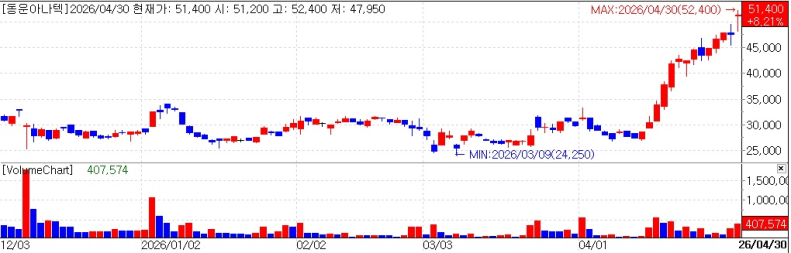
[Kim Jinsoo, Edaily Reporter] On the 30th, among pharmaceutical and biotech companies, DongWoon Anatech garnered investors' attention by increasing the likelihood of proving the efficacy of 'D-SaLife,' a saliva-based blood glucose meter that it is pushing to commercialize for the first time in the world.Subsequently, Biosolution's stock price rose as expectations for a Phase 3 clinical trial in the U.S. were reflected following the Chinese approval of its osteoarthritis cell therapy, CartiLife. ViGenCell transitioned back to an upward trend after continuously delivering positive news regarding its autologous immune cell therapy, VT-EBV-N.DongWoon Anatech Stock Trend. (KG Zeroin MP Doctor)DongWoon Anatech Surges 8%According to KG Zeroin MP Doctor (formerly MarketPoint), DongWoon Anatech's stock closed at 51,400 won on this day, up 8.21% from the previous trading day. The rise in DongWoon Anatech's stock price this month is analyzed to be driven by news regarding the potential to prove the clinical efficacy of the saliva-based blood glucose meter, D-SaLife, which is currently under development.On the 29th, DongWoon Anatech announced on its website that D-SaLife demonstrated high clinical efficacy in a clinical study conducted at Asan Medical Center in Seoul.For two months from October to November of last year, DongWoon Anatech conducted a clinical trial of the D-SaLife saliva glucose measurement system on a total of 121 general individuals and diabetic patients at Asan Medical Center. Following this, the company conducted a detailed statistical analysis of the clinical trial data until late March of this year.According to the results of this clinical trial, the clinical efficacy of D-SaLife was analyzed to be at a remarkably high level. The accuracy of quantitative blood glucose levels predicted by saliva in a fasting state showed a Mean Absolute Relative Difference (MARD) of around 8%. This is a significantly improved figure from the 12% MARD level measured in a clinical trial at Seoul St. Mary's Hospital three years ago. Furthermore, the accuracy of quantitative blood glucose levels predicted by saliva up to 2 hours after a meal was measured at a MARD in the 10% range.MARD is a figure representing the absolute percentage difference between the measurement of the test device and the reference device. Currently, globally commercialized CGM (Continuous Glucose Monitoring) devices generally have a MARD of 8~12%, while other various non-invasive blood glucose devices have MARD values around 10~20%.In addition, the 'ISO 15197:2013' regulation, which the Ministry of Food and Drug Safety (MFDS) uses as the standard for evaluating the clinical efficacy and safety of blood glucose meters, specifies that when general users measure their blood glucose, over 99% of the results must fall within zones A and B of the Consensus Error Grid (CEG). In this Asan Medical Center clinical trial, 100% of D-SaLife's blood glucose measurements fell within the A+B zones, and none of the 121 subjects who used D-SaLife experienced any adverse events.Professor Jung Chang-hee, who led this clinical trial, evaluated in the clinical result report, "This demonstrates the high potential of the completely bloodless and non-invasive D-SaLife as an alternative for diabetic patients who avoid BGM (Blood Glucose Monitoring) or CGM due to aversion to blood drawing, risk of infection, high costs, or inconvenience, as well as for high-risk diabetic groups such as those who are overweight, obese, or in the pre-diabetic stage." A representative from DongWoon Anatech stated, "The stock price seems to have risen as expectations for D-SaLife are reflected," adding, "Starting with the MFDS GMP review on the 11th of next month, we plan to proceed with the MFDS licensing schedule in earnest."Biosolution: Rises 8% on U.S. Clinical Trial ExpectationsBiosolution's stock closed at 11,990 won, up 8.02%. The rise in Biosolution's stock price on this day is interpreted as reflecting e
원문 보기 ↗