GI Innovation and Orient Bio Surge on S...
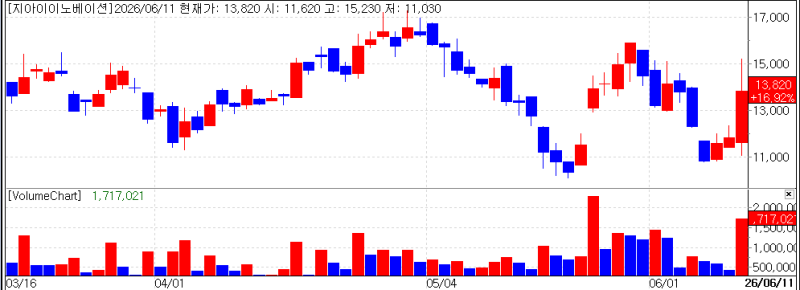
This article was released as Pharm Edaily Premium Content on June 12, 2026, at 8:00 AM.[Yu Jin-hee, Edaily Reporter] While the South Korean stock market continues to see foreign and institutional capital heavily concentrated in the semiconductor sector, the biotechnology segment successfully held its ground on June 11, buoyed by clear clinical milestones and strong corporate governance. Investor sentiment is rapidly coalescing around enterprises backed by solid earnings momentum and proactive management efforts to restore market trust.In particular, key anticipation stocks that demonstrated rigorous data validation and a commitment to responsible management stood out even amidst a broader market downturn. The three standout companies GI Innovation, Orient Bio, and L&C Bio all posted double-digit gains in overall market returns on the day, driving an upward rally for the bio sector by drawing in strong buying pressure.Recent stock price trend of GI Innovation. (Source: KG Zeroin MP DOCTOR)In-Depth Evaluation: GI Innovation Soars on Revolutionary 'GI-101A' Data Validated at Global Top-Tier Oncology ConferenceOn the day, GI Innovation (358570) surged by 15.40% from the previous trading day on the KOSDAQ market, closing at 13,640 won and landing at the top of the bio sector's gainers list. This performance was driven by a combination of a bullish analysis report from a prominent U.S. healthcare investment bank (IB) and powerful momentum ahead of an upcoming oral presentation at the world’s largest cancer symposium, triggering a wave of institutional and foreign buy orders.Recently, U.S. healthcare IB Leerink Partners highlighted GI Innovation’s next-generation immuno-oncology candidate, ‘GI-101A’, as a highly promising, market-disrupting program in its 'ASCO 2026' Immuno-Oncology Review Report. The report offered an in-depth analysis suggesting that while global oncology investment trends are currently overly skewed toward antibody-drug conjugates (ADCs) or VEGF/PD-1 bispecific antibodies, the true paradigm shift moving forward will be triggered in the Interleukin-2 (IL-2) bispecific fusion antibody (bs-fusion-Ab) space.Positioned at the center of this mega-trend, GI-101A is scheduled for an oral presentation of its Phase 1/2 clinical trial results at the American Society of Clinical Oncology (ASCO 2026) annual meeting on May 30 (local time). The presentation will be delivered by Dr. Jae-Lyun Lee, a global key opinion leader (KOL) in urologic oncology, drawing intense focus from global biopharma CEOs and business development (BD) executives. Out of numerous abstracts, the selection of an early-stage clinical dataset for an oral presentation session is a significant indicator that the global medical community values this core pipeline highly.The pre-released abstract data exceeded market expectations. In the effective dose cohort (0.2–0.3 mg/kg) of the monotherapy arm, a monumental milestone was achieved: a complete response (CR) was induced in a patient with refractory bladder cancer who had previously shown zero response to conventional immune checkpoint inhibitors. The patient's progression-free survival (PFS) was confirmed at 13.9 months a stellar figure that is more than double the previously reported PFS data (approximately 6 months) for Padcev, the current standard of care in clinical practice. Furthermore, a partial response (PR) was observed in a patient with immune-checkpoint-inhibitor-refractory malignant mesothelioma, further proving the candidate's anti-tumor activity.The combination therapy arm with the global blockbuster drug Keytruda (pembrolizumab) is equally encouraging. In the clear cell renal cell carcinoma (ccRCC) cohort which holds the most accumulated data among the 48 solid tumor patients enrolled the combination yielded an impressive objective response rate (ORR) of 40% and a disease control rate (DCR) of 70%. Even though 70% of the total patient population consisted of individuals who had already failed pr
원문 보기 ↗